As an Amazon Associate we earn from qualifying purchases.
Short answer: UGREEN model 90889 has three outputs and a 130W product headline; its official U.S. gallery shows the actual pictured splits, including 100W+30W on C2+C1 and 100W+12W+12W (124W total) with all three ports occupied. The input record is regionally inconsistent: the U.S. structured field says 24V, while UGREEN’s same-model U.K. page says 12–24V. If you need 12V compatibility in a U.S. vehicle, verify the exact unit label/manual before purchase. The selected U.S. option is charger-only, so supply your own cable. UGREEN U.S. listing
As an Amazon Associate, we earn from qualifying purchases.
On this page:
- Compare port combinations
- Check vehicle input voltage
- Plan laptop and phone charging
- Choose the right car charger
- Read common questions
This is a research-based guide, not a ProperlyGeek in-car test. Ratings and protocol details below are manufacturer specifications; actual charging depends on vehicle voltage, device negotiation, cable, and simultaneous loads.
What the three ports are rated to do
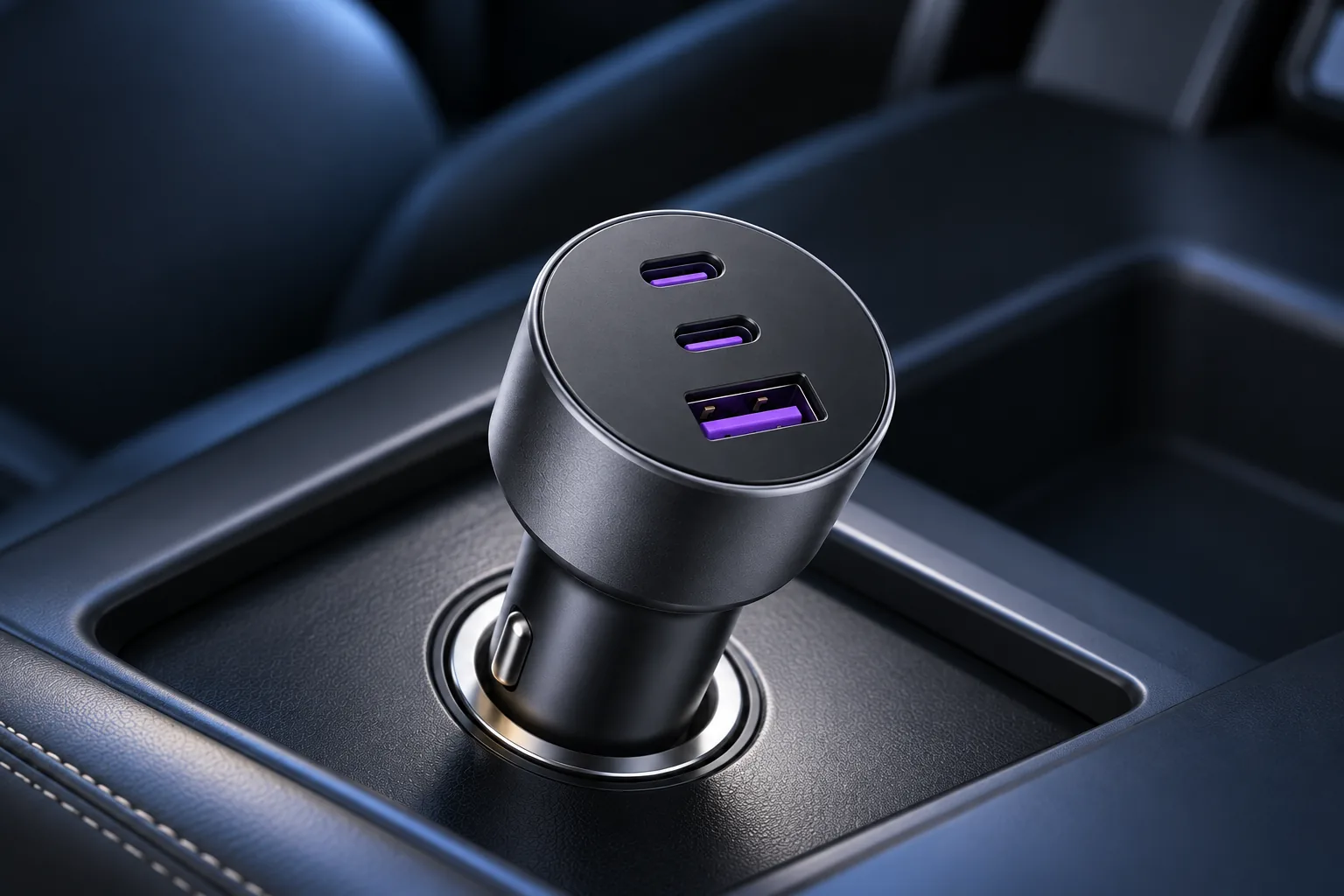
UGREEN identifies the product as model 90889, with two USB-C ports and one USB-A port and 130W total advertised output. On the U.S. product page, USB-C2 is the high-power port rated up to 100W PD, USB-C1 up to 30W PD, and USB-A up to 22.5W using supported fast-charge protocols. UGREEN’s localized specifications additionally list PD 3.0, QC 3.0/4+, PPS on USB-C2, and various Huawei/Samsung/Apple protocols by port. UGREEN U.S. 90889 page UGREEN U.K. 90889 page
| Port | Individual maximum shown | Best use |
|---|---|---|
| USB-C2 | Up to 100W PD | Laptop or tablet needing USB-C PD; confirm cable and device requirements. |
| USB-C1 | Up to 30W PD | Phone, smaller tablet, or accessory. |
| USB-A | Up to 22.5W | Legacy USB-A cable/device using a listed compatible protocol. |
UGREEN’s official U.S. gallery gives these representative shared-output allocations: two-port chart and all-three-port chart.
| Active ports | Gallery allocation shown |
|---|---|
| C1 + C2 | C1 30W + C2 100W |
| C2 + USB-A | C2 100W + USB-A 22.5W SCP or 18W QC |
| C1 + USB-A | C1 12W + USB-A 12W |
| C1 + C2 + USB-A | C2 100W + C1 12W + USB-A 12W = 124W |
The product headline is 130W, while the charted all-three configuration totals 124W. These are manufacturer-published example allocations, not proof that every connected device will negotiate those exact rates: the device, cable and protocol still matter. The chart does answer the main port-sharing cases, so laptop-plus-phone use can be planned against the pictured row instead of guessed from the individual maxima.
Check the car socket and input voltage
The exact-model regional records conflict and this matters to a typical U.S. driver: the U.S. 90889 listing’s structured field says “Input Voltage: 24 Volts,” while UGREEN’s exact-model U.K. page says “Input DC 12–24V/14.6A.” The U.S./Canada record also carries a 24V field. The U.K. source supports a 12V claim for that region’s record, but it does not conclusively establish the input rating printed on a U.S. unit. If your vehicle has a 12V socket, verify the U.S. unit label/manual before relying on this charger, especially for a high-power load. Exact UGREEN U.S. 90889 listing UGREEN U.K. specifications UGREEN Canada listing
A car charger also depends on the socket being powered. Some vehicles keep the 12V outlet live when parked; others switch it with ignition or accessory mode. This product is not a replacement for a household wall charger and cannot be used directly from AC mains. Avoid routing cables where they can interfere with pedals, steering, airbags, or driver visibility.
Using the 100W port for a laptop
Use USB-C2 for a laptop that accepts USB Power Delivery. The charger’s “up to 100W” rating is a maximum negotiated output, not a promise that every laptop will charge at 100W. The laptop may request less, and heavy workloads can consume power faster than the adapter supplies it.
For a full 100W USB-C PD connection, choose a cable rated for 5A with the required electronic marker; an ordinary 3A cable may limit the available power. USB-IF’s cable guidance explains that higher-current Type-C cables need identification to safely support the current. The UGREEN U.S. page says the selected U.S. variant is charger-only; it does not include the optional 100W cable in that chosen configuration. Confirm this in the cart before ordering. USB-IF USB-C cable overview UGREEN U.S. options
Use your laptop maker’s required power and cable information. A 100W-capable adapter may be undersized for a workstation that expects more, while a laptop drawing below 100W can use the port without being forced to take its maximum. USB PD is negotiated between the source and device. USB-IF USB Power Delivery
Phone compatibility and realistic charging expectations
USB-C1’s 30W ceiling is the natural phone port when USB-C2 is occupied by a laptop. The U.K. product page lists PPS on USB-C2 and a broad set of fast-charge protocols across the ports, but the exact port-to-protocol matrix should be checked for the region and revision you buy. A generic statement that a port supports “fast charging” cannot tell us a phone’s exact speed.
Google recommends compatible PD or PPS adapters for Pixel phones and asks users to check the exact model’s requirements. Samsung’s 45W Super Fast Charging 2.0 requires a compatible 45W-class supply and appropriate cable; USB-C1’s 30W maximum cannot satisfy a 45W peak, while USB-C2 has a 100W ceiling but protocol negotiation and cable still determine whether a particular Samsung model reaches its supported mode. Google Pixel charging support Samsung 45W charging guidance
For USB-A devices, the 22.5W headline applies only to compatible devices and protocols. It does not mean a USB-A cable will fast-charge every new phone, and USB-A cannot provide USB-C PD laptop power. If you rely on a proprietary protocol, confirm that both the specific port and phone generation support it.
Is model 90889 the right car charger?
Choose it if you need a vehicle adapter with a high-power USB-C PD port plus two additional outputs, and the exact unit input label matches your vehicle. UGREEN’s gallery shows C2+C1 at 100W+30W and all-three use at 100W+12W+12W, which gives concrete planning guidance. A U.S. buyer with a 12V socket should resolve the regional input discrepancy by checking the delivered unit label/manual before depending on it.
Choose a lower-power, simpler car charger if you only charge phones and want a smaller price or footprint. The gallery chart covers representative combinations, but choose another charger if your exact device/cable negotiation requires a guaranteed rate not shown in those rows. The 130W product headline does not mean the charted all-three use reaches 130W.
Purchase checklist: verify model 90889; select the correct U.S. plug-in accessory (car socket); resolve the 12V/24V discrepancy against the exact U.S. unit label/manual if your socket is 12V; use a 5A e-marked cable for 100W; check that the selected listing option is charger-only; and use the official chart rows for the port combination you plan to occupy.
FAQ
Can the UGREEN 90889 deliver 130W to one laptop?
The U.S. page lists up to 100W from USB-C2, not 130W from one port. The 130W figure is the product’s total output rating across the charger.
Can it charge a laptop and two phones at full speed together?
UGREEN’s gallery shows C2 at 100W, C1 at 12W, and USB-A at 12W in the all-three configuration, for 124W combined. It does not show all three individual port maxima operating together.
Does the U.S. package include the 100W cable?
The selected U.S. option is charger-only. A separate cable option may be offered; verify the cart selection and cable rating.
Is it compatible with a 24V vehicle?
UGREEN’s U.K. same-model page states 12–24V, while the U.S. structured field says 24V. If you need 12V, check the exact U.S. unit label/manual before purchase; the U.K. page alone does not settle the U.S. unit rating.
Model 90889’s strongest use case is one laptop on USB-C2 with secondary charging at the charted allocations. Its U.S. input field conflicts with the same-model U.K. 12–24V record, so a U.S. buyer relying on a 12V socket should confirm the exact unit label/manual before use.
Header image: AI-generated editorial illustration, not a product photograph or test setup.