As an Amazon Associate we earn from qualifying purchases.
Short answer: AOHi’s current U.S./Japan “140W Charger” Magcube Pro listing is a three-port wall adapter for buyers who want a high-power USB-C port plus two additional outputs. The page specifies 100–240V AC input, 2 USB-C ports and 1 USB-A port, up to 140W from either USB-C port individually, and 140W total shared output. It does not provide a complete wattage table for every simultaneous port combination, so do not assume both USB-C ports deliver 140W together. AOHi U.S./Japan product listing
As an Amazon Associate, we earn from qualifying purchases.
On this page:
- Identify the US/JP variant
- Review port and power sharing
- Check the full-power cable
- Assess phone and tablet fit
- Decide whether it fits your setup
This is manufacturer-document research, not a ProperlyGeek hands-on test. The page calls the selected variant “140W US/JP Charger”; it does not expose a model/SKU identifier, so we do not map it to a presumed older model number. Confirm the exact style before ordering.
What the current US/JP listing identifies
AOHi’s product page presents a 140W GaN wall charger and a style selection for “140W US/JP Charger,” distinct from its EU option. The selected U.S./Japan version is therefore the scope of this guide. The page does not provide a clear model code, and the similarly named Japan-region Magcube page is not enough to prove every internal component or certification is identical. Use the exact current listing and plug style rather than matching by product-family nickname alone. AOHi U.S./Japan listing AOHi Japan Magcube page
The U.S./JP listing says input is 100–240V AC and describes a foldable plug. That voltage range is appropriate for common international mains voltages, but a plug adapter may still be needed outside the U.S./Japan. Check the electrical label on the delivered unit and local outlet shape; voltage compatibility does not change the plug shape or local safety requirements.
Port ratings and the 140W sharing limit
AOHi lists two USB-C outputs and one USB-A output. Its specification table gives USB-C1 and USB-C2 individually up to 140W, with USB Power Delivery output modes up to 28V/5A and PPS from 3.3–21V/5A. The page also states a 140W total output ceiling and describes automatic redistribution as devices are connected or disconnected. That means the two USB-C 140W figures are alternative single-port maxima; the charger cannot supply 140W from each simultaneously while also staying within the 140W total. AOHi product specifications
| Use | What the page supports | What remains unspecified |
|---|---|---|
| One device on USB-C1 or C2 | Up to 140W, with listed PD and PPS profiles | Actual device negotiation and cable capability |
| One laptop plus a second device | Charger redistributes output; total is capped at 140W | Exact split for each port combination |
| USB-A accessory | AOHi lists up to 33W and proprietary/legacy protocols | Phone-specific speed and simultaneous split |
| All three ports occupied | Three-port use is supported by design | Do not infer three individual maxima at once |
AOHi’s page describes dynamic power allocation but does not give a full table that lets us promise, for example, a specific wattage on C1 + C2 + A together. If a laptop must maintain a guaranteed load while another device is connected, ask for or locate the revision-specific manual table before buying. Otherwise, prioritize the laptop on a USB-C port and treat other simultaneous charging as variable.
The cable needed for full 140W output
The charger’s 28V/5A mode is USB PD 3.1 Extended Power Range territory. To carry 5A safely, USB-C cables need to be appropriately rated and electronically marked; not every USB-C cable supports that current or EPR voltage. USB-IF describes the PD 3.1 extension up to 240W and Type-C cable requirements. USB-IF USB Power Delivery USB-IF Type-C cable information
AOHi’s current product listing identifies the charger and manual in its package contents, not a USB-C charging cable. Plan to use a compatible 5A EPR cable for a device that can request the full 140W, and verify the live box-contents section at checkout. A cable included with an older AOHi kit or a sibling charger does not establish the contents of this selected variant.
The device also needs to support the relevant PD mode. Apple lists 140W or higher USB-C power adapter charging support for the 16-inch MacBook Pro in its technical specifications, but the precise charging setup depends on Apple’s model and cable guidance. AOHi says the charger is compatible with MacBook, but that broad statement is not an independent test or guarantee of an Apple-specific maximum. Apple 16-inch MacBook Pro specifications Apple Mac power adapter guidance
Phone and tablet compatibility
A 140W adapter does not push 140W into a phone. The connected device negotiates power and draws only what it supports. For Samsung phones, AOHi lists compatibility with 45W Super Fast Charging 2.0, but achieving that behavior depends on the exact Galaxy model, the port’s PPS negotiation, and an appropriate cable. Samsung’s support guidance identifies 45W equipment requirements; do not infer SFC 2.0 from “USB-C” alone. Samsung 45W charging guidance
For other phones and tablets, compare the manufacturer’s required protocol and maximum input with AOHi’s published profiles. A device that uses USB PD can generally negotiate a lower compatible mode, while proprietary modes may require a matching charger. AOHi lists USB-A modes including up to 33W and UFCS, but this does not mean every USB-A phone supports those rates. If you need a phone’s exact fastest mode, find its official charging specification first.
Is this charger a good fit?
The Magcube Pro US/JP variant is a strong candidate when one high-demand laptop may need up to 140W and you also want two extra ports for accessories. It is less suitable if you need a documented simultaneous allocation for a precise laptop-plus-tablet setup, a charger with a bundled full-power cable, or a precisely identified model code for corporate procurement.
Consider a 65W or 100W adapter if your laptop’s actual requirement is lower and portability matters more than headroom. Conversely, do not assume the charger will satisfy a laptop whose manufacturer requires more than 140W or uses a proprietary power system. Check the exact computer model, its adapter recommendation, and the needed cable.
Before buying, confirm: (1) style says 140W US/JP Charger; (2) the delivered plug matches your outlet; (3) the product label supports your mains voltage; (4) your laptop accepts USB PD at the expected rate; (5) your cable is rated for 5A EPR; (6) you understand that 140W is total shared power; and (7) the current box includes what you expect.
U.S. ordering and shipping limits
AOHi’s policy describes U.S. and international shipping, and says warehouse location and processing can vary. The product page showed an Add to cart control when checked, but that is not a destination-specific shipping confirmation. No postal address was entered, and no guaranteed arrival date can be stated. Confirm stock, plug style, shipping destination eligibility, and delivery estimate at checkout. AOHi shipping policy
FAQ
Can both USB-C ports output 140W at the same time?
No. AOHi lists 140W per USB-C port as an individual maximum and 140W total shared output. Connecting more devices triggers redistribution; the page does not show every combined split.
Does it include the cable for 140W laptop charging?
The product page’s package list shows the charger and manual, not a USB-C cable. Verify the exact listing at checkout and plan for a 5A EPR cable if your device uses 28V/5A.
Is this the same as the Japan Magcube 140W listing?
The current U.S./Japan variant is the one documented here. A similarly named Japan page does not prove an identical SKU or certification; AOHi’s U.S./Japan product page does not expose a model code.
Will it fast-charge a Samsung phone at 45W?
AOHi claims compatibility with Samsung 45W SFC 2.0, but the exact phone, port, PPS negotiation, and cable govern the result. Verify the phone maker’s requirements; the charger’s 140W headline alone does not prove 45W operation.
Buy the AOHi when its high single-port ceiling and three-output design match your setup, and you can supply a suitable cable. Treat 140W as the total budget, not a promise that each port receives its individual maximum concurrently. The absent sharing matrix and model identifier are the two details to resolve if your purchase depends on exact allocation or procurement traceability.
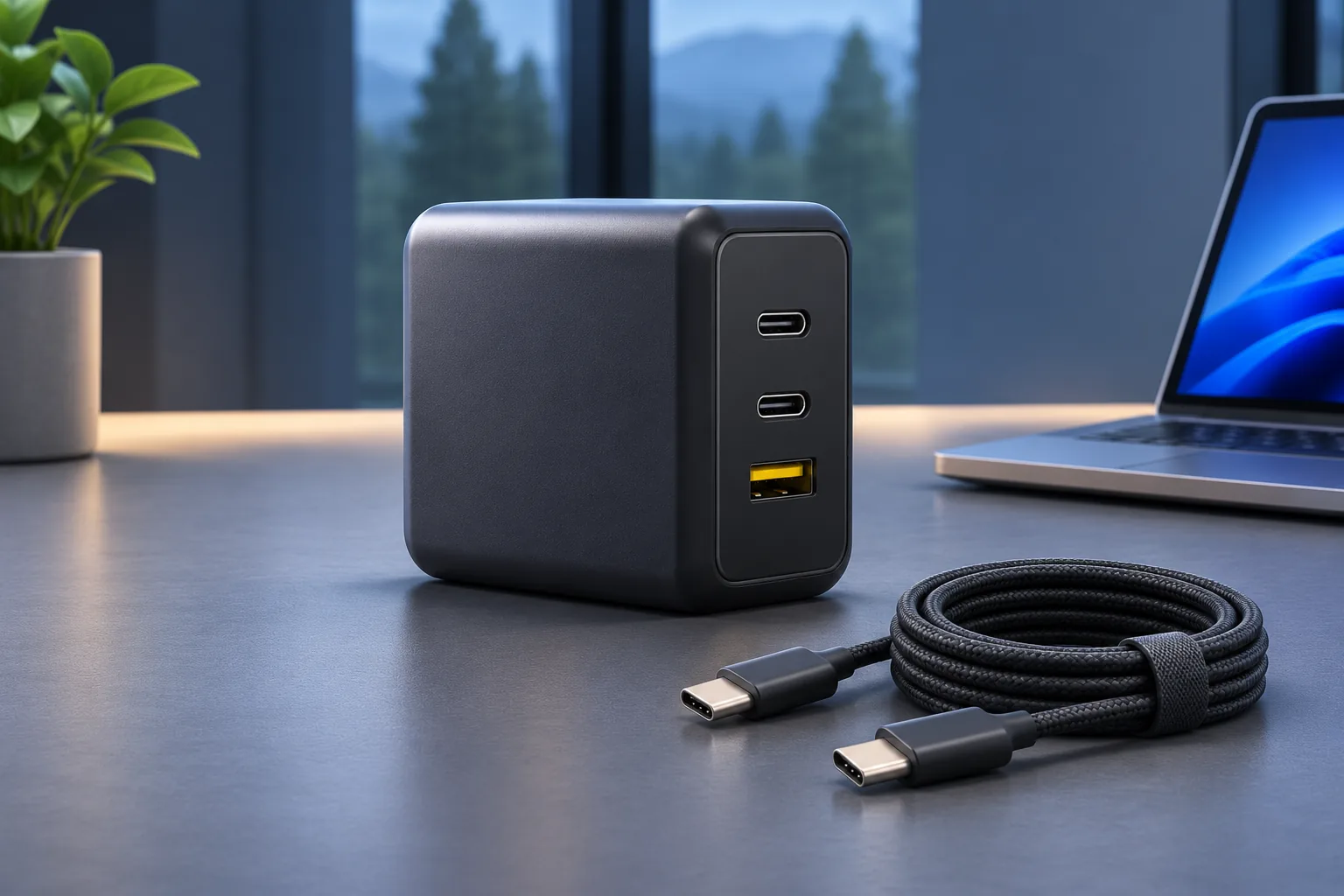
Header image: AI-generated editorial illustration, not a product photograph or test setup.